Any Android phone
Download the APK from GitHub Releases and open it to install. The first time, Android asks you to allow installs from your browser.
Release notes on GitHubSotreus is a private instrument for the space around you. An Android app — with a pocket Edge companion — that shows what nearby electronics are broadcasting, remembers what you have encountered before, and adds airspace and orbital context.
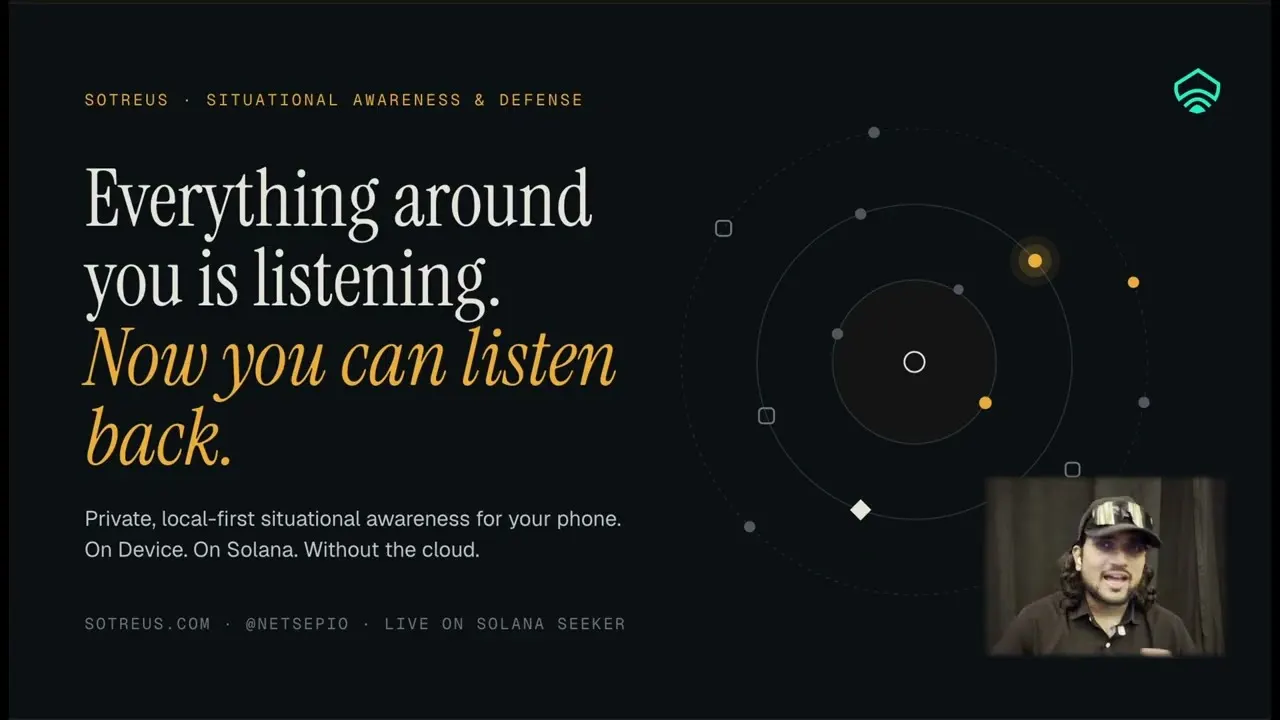
Nothing loads from YouTube until you press play.
Download the APK from GitHub Releases and open it to install. The first time, Android asks you to allow installs from your browser.
Release notes on GitHubOn a Seeker or another Solana Mobile phone, install Sotreus from the Solana dApp Store, which also delivers its updates.

On a computer? Open this page on your Solana phone.
Install one build, not both. They share the package name com.sotreus.app but are signed with different keys, so neither can update the other.
Surveillance no longer has a single shape. Cameras, doorbells, trackers, access control, beacons, drones, vehicle electronics, building sensors and aircraft all add to an environment that is electronically dense — and hard to read.
The problem is asymmetry. Infrastructure can sense, log and correlate. The person moving through it usually has no comparable view.
Sotreus closes part of that gap — honestly, and only with what your devices can legitimately observe.
Your Android phone is the first sensor. Sotreus observes nearby Bluetooth LE and visible Wi-Fi, learns what is normal for a place, and keeps the evidence on your device.
How many radios and device families are visible right now.
What matches this place, or devices you have already tagged as yours or expected.
What is new, unusually persistent, or different from your previous visits.
Which tagged or fingerprinted entities have appeared somewhere else.
Nearby aircraft, drone Remote ID broadcasts and satellite passes — when you turn context on.
The meaningful question is not only “what is nearby?” but “have I encountered this before?” Local memory turns a noisy stream of radios into something you can read.
Matches this place’s baseline or a device you have marked as yours or expected.
Not seen in this place before. Most new things are ordinary — Sotreus simply notes them.
Present for an unusually long stretch of a session, rather than passing through.
A distinctive fingerprint seen again in a different, unrelated place.
Electronic awareness does not stop at the walls of a room. When you choose, Sotreus places aircraft, drone broadcasts and satellite passes on the same timeline as your local observations — and never blurs where each one came from.
Observed directly by your phone or Sotreus Edge — BLE, Wi-Fi and compatible Remote ID broadcasts.
Reported by an external provider over the internet. Always shown with its source and data age.
Computed on your device from public orbital elements. Your location never leaves the phone.
Sotreus may say events overlapped in time. It will never say one caused the other. Temporal correlation stays temporal correlation.
Sotreus does not promise to find every camera or tell you who is watching. It gives you evidence — radio signatures, recurrence, proximity patterns, known device families and changes in a place — and shows the source of each.
You decide what that evidence means.
| OTHER APPS SAY | SOTREUS SAYS |
|---|---|
| Needs attention | |
| Camera-family signature observed | |
| Repeated cross-location re-encounter observed | |
| Aircraft reported within selected radius | |
| Selected satellite predicted overhead | |
| Remote ID broadcast observed | |
| Nothing observable on supported bands | |
| Last observation · data freshness |
Sotreus Edge scans, timestamps and stores on its own battery, then syncs to the app over Bluetooth. The app stays the brain. Edge becomes the always-on sensing layer.
Edge Mode — the everyday default. Continuous or duty-cycled BLE and 2.4 GHz Wi-Fi observation, a local append-only log, optional GNSS, and no LoRa transmission.
Honest boundary: Edge is not an ADS-B or satellite receiver. Aircraft context stays network-reported and orbital context stays predicted.
PROTOTYPE BASELINE · HELTEC WIFI LORA 32 V3
| PHONE ONLY | PHONE + EDGE |
|---|---|
| Observation depends on Android scan cadence and power policy. | Edge keeps its own schedule while the phone sleeps. |
| A journey can lose coverage when the app is constrained. | Edge keeps logging and syncs the full session later. |
| Phone location is the only location source. | External GNSS anchors Edge observations independently. |
| Battery cost is paid by the phone. | A dedicated battery isolates the sensing workload. |
| No LoRa hardware. | The same node switches to Meshtastic for off-grid comms. |
An awareness tool fails if it becomes another opaque collector. Sotreus is built so it can’t.
Scanning, memory, tagging and reports work without signing up for anything.
No mandatory cloud. Your radio history and places stay on your device, with optional encryption at rest.
Aircraft and orbital feeds are modules you switch on. Local sensing works fully offline.
Sky queries run in Exact area, Coarse area or Off. Satellite passes are computed without sending your location anywhere.
Exports default to coarse coordinates, time buckets and hashed identifiers.
Keep everything, keep N days, keep tagged only — or delete a place or session outright.
What is yours stays on your devices. What is around you is shown, and its source stays clear.
Sotreus never:
BLE + visible Wi-Fi · Encounter memory · Places + journeys · Aircraft, drones + satellite passes
ESP32-S3 + BLE + 2.4 GHz Wi-Fi · Local storage + optional GNSS · Continuous observation · Mesh Mode via Meshtastic
Phone + Edge encounters · Across time and place · 360° physical protection
Sotreus answers with evidence, provenance, confidence, freshness — and restraint. The Android app is out now. Join early access for the first Sotreus Edge field units.
Follow progress on X · @netsepio